If you’ve read some of my previous posts, you’ll know that the Monk is one of my absolute favorite classes in all of gaming, check out this post for more details.
Dungeons and Dragons 5e is one of the most balanced gaming systems available online, meaning you can make anything work. So long as the gaps in the party are sufficiently filled, you can get away with any build, unless you’re going for the min-max approach, which is what this guide will entail.
Introduction
Not to repeat myself, but there’s just something so rebellious about existing in a world of magic, swords and dragons and spitting on all of their faces and saying, “Screw it! I’ll just use my fists instead!”
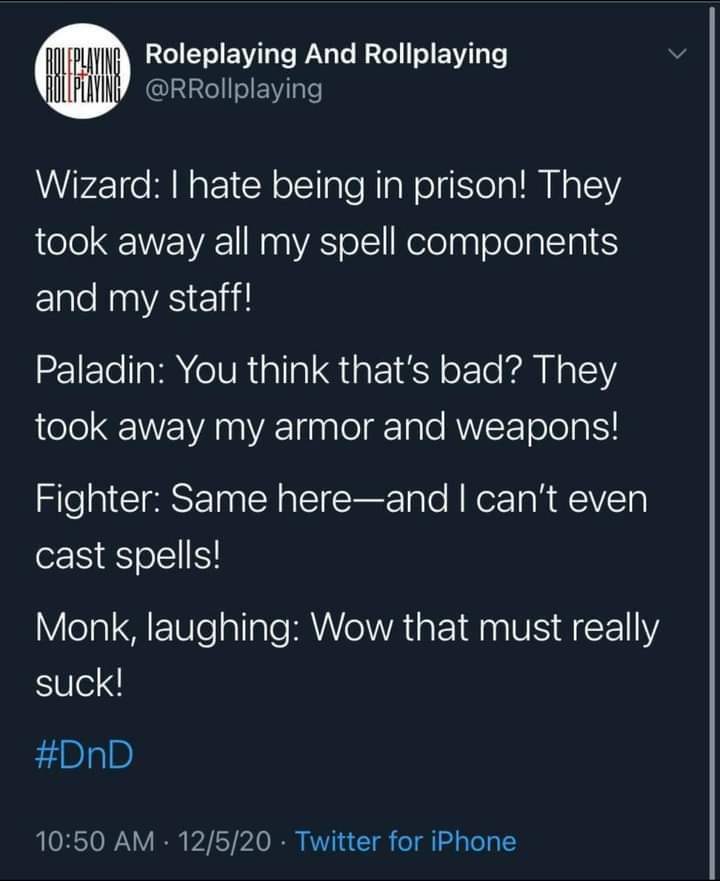
This just about sums up what playing a Monk is all about. 5e gave Monks some very interesting combat options and also give many options with regards to roleplay. I’m not going to get into the argument of which is more important, but the monk really can go either way depending on your personal play style.
As a party member, Monks often take the role of a Fighter-equivalent for those who want to be a fighter, but find the class too boring and generic. With their high Dexterity and the right skillset, they can also play a Rogue-equivalent. In summary, Monks try to bridge the gap between the two and depending on the setting and party composition, they are fairly easy to fit into any party to fulfill either role.
Before we actually get started with optimization, we need to understand what makes the Monk function, and what are the best ways to maximize their potential.
Monks are mostly ruled by their Dexterity stat, their Unarmed Strikes and weapon attacks scale off Dexterity and it also adds to their AC.
AC is important, as front line Strikers, Monks are going to draw quite alot of fire, and because they cannot wear armor and have the lowest HP of any martial class. Thankfully, Monks have a way to get some pretty high AC with a high Wisdom score. Similarly to Dexterity, Wisdom is important both in and out of battle so you’ll want this score high anyway.
Constitution is also needed, because its Constitution. Not really much I can add here.
Pros
Before you actually start building your Monk, its important to first weigh your options and see if this class is the perfect fit for you. Here’s some of the pros to playing Monks.
- Very Self-Sufficient, Monks do not rely on equipment both offensively and defensively
- Excellent role-play opportunities
- Decent Skill options
- High level features are borderline broken
- Brilliant speed
- Access to powerful options like Stunning Strike
Cons
Make no mistake, like any other class, Monks do have some inherent flaws, most of which can be filled by other party members, but can be annoying to you at times.
- Slow start. While some features at high levels are excellent, Monks can struggle in the early game due to a variety of reasons such as a low damage dice, and low ability scores.
- Dependent on three ability scores. This is a tough one, because while Monks do need high scores in three abilities, they do have three dump abilities as well.
- Lack of ranged options
- Low HP
- Lack of any good crowd control measures.
Getting Started
You’ve gone through your options and spent many a sleepless night considering your life and its direction. Now, you’ve reached the point where decisions need to be made and your gut keeps telling you to be Monk. Congratulations! However, this is unfortunately only the first of many decisions you need to make before you can happily start punching things into oblivion.
First, you need to choose the basic things such as gender, height, weight and bio. These will have little effect on your actual gameplay, and it’s mostly just flavor for your roleplay.
Race
Unlike the other things, Race is more than just a flavorful aesthetic feature, but a core part of your game play.
The most important function of your race is its natural addition to your ability scores. Most races give a +2 to one ability, while your choice of sub race will give a +1 to another stat. In addition, many of them will give you access to other features that can help plug holes in your skillset that the Monk features do not necessarily fill.
Elves
As stated earlier, Dexterity is the most important ability score for the Monk. With a natural +2, Elves seem like a natural fit to be Monks. Wood Elves take it a step further by adding +1 to Wisdom. Some elvish features like Trance, Fey Ancestry and Darkvision really help out, seeing as Monks have no way to get these moves naturally. Pallid Elves have the same Ability increases, but I think Wood Elves have better Racial Features.
The only really problem I have with using Elves as Monks is that its difficult to roleplay. Elves have a chaotic bent, while every bit of lore states that Monks require rigorous study and discipline. Basically, the two sit in opposition, but this is really just nitpicking on my end
Aarakocra
This Winged race was given to use in Xanathar’s Guide to Everything and immediately feels perfect for a monk. +2 Dexterity and +1 Wisdom matches the bonus of Wood Elves and Aarakocra also brings a powerful feature in Flight, which combines brilliantly with a Monk. Their low ground speed isn’t much of an issue, as Monks gain Unarmored Movement to compensate.
Again, the problem here is one of lore. Many people aren’t really familiar with these birdmen and playing one can prove a challenge for most.
Halfling
Similar to Elves, all halflings come with a +2 Dexterity bonus, which already gives them an edge over other races. Lotusden and Ghostwise variants both get a +1 to Wisdom, putting them on the same level as Wood Elves and Aarakocra. Stout halflings instead put their +1 to Constitution which isnt a bad thing per se, but Wisdom fuels both AC and your Ki save DC, so I would prioritize Wisdom.
With regards to choosing sub race, I would pick the Lotusden. Access to some Druid spells will give your Monk some utility outside of just punching things, and will also provide some awesome control options.
Humans
Humans are a race that’s pretty much good at anything. Having a +1 to all Ability Scores is excellent on a class dependent on so many scores. However, the Variant Human gets you a +1 to two scores of your choice (Dexterity and Wisdom) as well as a feat and skill proficiency.
Feats are somewhat hard to come by in D&D, forgoing an ability score increase is a major sacrifice, so having one available at Level 1 provides a significant advantage.
Half-Elf
Half Elves represent a bit of a challenge for the Monk. On one hand a free +1 to two scores is good, but the +2 Charisma is useless. You will get a few extra features depending on the variant, but I think the flat +2 Dexterity from a pure elf is worth more than the rest. All the same, Half Elves are almost as good as humans when it comes to functioning in any role.
Dwarves
I only mention this one for the sake of completion. Dwarves do offer a +2 Constitution which will help out with your bulk, add in Dwarven Toughness to further pad your HP and you won’t die as easily. Hill Dwarf is probably your best bet with a +1 to Wisdom. Unfortunately, all of this comes at the expense of Dexterity; your most important stat.
Overall, I wouldn’t recommend playing a Dwarven Monk, the cost to Dexterity leaves too much of a glaring hole in your build to be optimal.
None of the other races offer enough to be truly useful as a Monk, so I wont go over them here, but as I said before, the nature of 5e is such that you can make do with anything, but this post is all about optimizing your build.
At this point it appears the Wood Elf is the best choice, and the one we will be using in our sample build. Access to Darkvision and Step of the Wild will go along way in helping us play to the Monks Strength, while the extra weapon proficiencies get us Long Bows for Ranged combat if necessary. This also gets us access to pretty nice feat at higher levels as well.
Background
Now that we’ve dealt with races, we now need to move onto backgrounds. Backgrounds are a good way to pick up new skill proficiencies, languages etc which helps you out with Role Play as well as certain in game mechanics. I will only be listing the best backgrounds here.
Monks rely on high scores in Dexterity and Wisdom, so a Background with access to skills making use of those ability scores is the best course of action. Monks eventually pick up Tongue of the Sun and Moon, so extra languages are meaningless.
Urchin
Being an Urchin nets you proficiency in Stealth and Sleight of Hand, both skills make use of your high Dexterity. Thieves Tools will allow you to play a Rogue equivalent quite well. Your Charisma is likely to be poor, so the Disguise Kit is less useful. But overall, I think the Urchin background is the best for what the Monk is good at.
Hermit
Medicine will capitalize on your high Wisdom and while Religion is an important skill, your Intelligence is not likely to be very high, so don’t expect to make much use of it. AbA Herbalist Kit will allow you to brew some Health Potions which is a valuable asset, despite being very time consuming. Hermit is the suggested background for Monks, but I think Urchin makes better use of your Stats.
Far Traveler
Both Insight and Perception are valuable skills and Monks have the Wisdom to use them effectively. The feel of this background fits perfectly with the Monk’s exotic flavoring. Also, Monks have the lowest starting gold of all classes, so having a bit extra is welcome.
I’m gonna go ahead and choose Far Traveler because Perception is perhaps the most important skill in D&D and we have few other ways to pick it up. Further more, Monks can get a hold of Stealth anyway. Now that were past the nitty gritty stages, we can move to the more important part!
Ability Scores
In every game of D&D I’ve played, I prefer to roll for my stats. My DMs usually allow one reroll and when I’ve taken the mantle of DM, I do the same. However I cannot guarantee that your DM will allow this, so instead we’re going to go with the standard array of scores.
Using this method nets us a 15, 14, 13, 12, 10 and 8. Point buy is an option, but I find three 15s and three 8s to be suboptimal. You’ll be good at some stuff, but severely crippled with your other scores which will give you some problems with saving throws and other ability checks.
Dexterity is our top priority, with Wisdom coming in as a close second as much of the Monk’s key features are powered by Wisdom. Constitution is important for everyone, so we need an at least decent score there.
The other three scores can typically be dumped by a Monk. However, it does need to be said that their are some debilitating effects that target Charisma, whereas Intelligence saves are rare. Furthermore, you likely have a wizard or cleric that can handle Knowledge Skills better than you can. This means that we can prioritize Charisma over Intelligence.
Our bottom priority is Strength. Strength may seem like an important attribute for a front line character, but you’ll find that Dexterity stands in for Strength in many situations like escaping grapples.
And with that, let’s begin building our mouth!
Level 1
At level 1, we begin with the following features and stats.
After applying racial bonuses, out attributes are as follows:
- Strength: 8 (-2)
- Dexterity: 17 (+3)
- Constitution: 13 (+1)
- Wisdom: 15(+2)
- Intelligence: 10(+0)
- Charisma: 12 (+1)
We also have the following proficiencies, including those from our background and race.
- Simple Weapons, Long Swords, Short Swords, Short Bows and Long Bows
- Common, Elvish, Abyssal
- Insight, Perception, Stealth and Acrobatics
- Strength and Dexterity saving throws
I’ve gone ahead and chosen Stealth and Acrobatics for Skills as both will make use of our high Dex score. I’ve also chosen Abyssal as an extra Language because demons are a common enemy type and are found across the entire CR range.
Next let’s go over the features we have at Level 1, starting with our Racial feats and then those given to us by the Monk Class
Darkvision – Racial
Accustomed to twilit forests and the night sky, you have superior vision in dark and dim conditions. You can see in dim light within 60 feet of you as if it were bright light, and in darkness as if it were dim light. You can’t discern color in darkness, only shades of gray.
It’s difficult to overstate how important being able to see in the dark is. Yes, mages can cast this fairly easily, but freeing up one of their precious spells because you have it automatically saves everyone some time. This also makes you more self sufficient.
Fey Ancestry – Racial
You have advantage on saving throws against being charmed, and magic can’t put you to sleep.
Charm is one of the most annoying debuffs in the game. Most charm effects force Charisma saving throws, which we won’t be good at, so advantage will definitely help us out in this regard. We’ll pick up a great feature in a few levels to further protect us from charm, but this will help keep us safe until then.
Trance – Racial
Elves don’t need to sleep. Instead, they meditate deeply, remaining semiconscious, for 4 hours a day. (The Common word for such meditation is “trance.”) While meditating, you can dream after a fashion; such dreams are actually mental exercises that have become reflexive through years of practice. After resting in this way, you gain the same benefit that a human does from 8 hours of sleep.
This comes in handy more often than one would think. It seems like mere flavor at first glance, but in a party with more than one elf, you can easily rotate watches making it difficult for enemies to get the jump on you while taking a long rest. This is especially important if you are forced to take a rest in the middle of an enemy fortress.
Fleet of Foot
Your base walking speed increases to 35 feet.
Monks are already the fastest class in the game. For a class so strongly tied to melee, extra speed always comes in handy when you need to get up close and personal.
Mask of the Wild
You can attempt to hide even when you are only lightly obscured by foliage, heavy rain, falling snow, mist, and other natural phenomena.
Handy in the right campaign, such as Tomb of Annihilation. Otherwise, this won’t see much use. Still, it’s an awesome option when it comes up.
Unarmored Defense
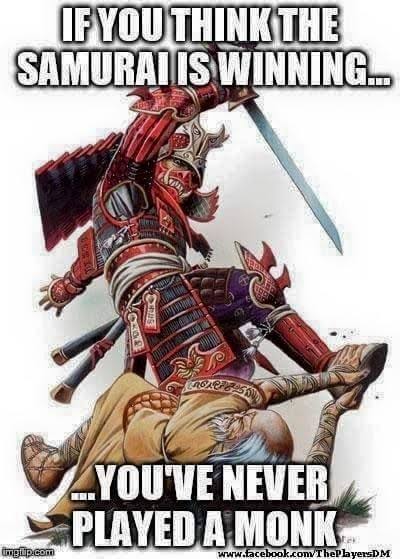
Beginning at 1st level, while you are wearing no armor and not wielding a Shield, your AC equals 10 + your Dexterity modifier + your Wisdom modifier.
We don’t get proficiency in shields or any kind of armor, so this gives us a great way to compliment our AC. Our goal is 20 Dex and 20 Wis, which will translate to 20 AC, the highest possible outside of magic equipment.
Martial Arts
At 1st level, your practice of Martial Arts gives you mastery of Combat styles that use unarmed strikes and monk Weapons, which are shortswords and any simple Melee Weapons that don’t have the Two-Handed or heavy property.
You gain the following benefits while you are unarmed or wielding only monk Weapons and you aren’t wearing armor or wielding a Shield.
• You can use Dexterity instead of Strength for the Attack and Damage Rolls of your unarmed strikes and monk Weapons.
• You can roll a d4 in place of the normal damage of your Unarmed Strike or monk weapon.
• When you use the Attack action with an Unarmed Strike or a monk weapon on Your Turn, you can make one Unarmed Strike as a Bonus Action. For example, if you take the Attack action and Attack with a Quarterstaff, you can also make an Unarmed Strike as a Bonus Action, assuming you haven’t already taken a Bonus Action this turn.
This is the Monk’s defining feature. Monk weapons are basically any simple weapon without heavy or two handed, so any simple weapon with versatile, such as a spear is our best bet. Note that this means we can use our Dexterity to attack even if the weapon isn’t necessarily a a finesse weapon.
The best part of this is being able to make an Unarmed Strike as a bonus action. Until level 5, this only amounts to an extra 1d4, which is still a nice bonus to our damage. At first level, with our stats this amounts to 8-18 damage if we use a spear two handed, off to a good start already.
So at level 1, we have 9HP, which is below average, but we will hopefully be able to avoid damage with our 15AC
Level 2
We get two new features at this level.
Unarmored Movement
Starting at 2nd Level, your speed increases by 10 feet while you are not wearing armor or wielding a Shield. This bonus increases when you reach certain monk levels, as shown in the Monk table.
At 9th level, you gain the ability to move along vertical surfaces and across liquids on Your Turn without Falling during the move.
An extra 10 feet of movement puts us 45 feet total. This makes it easy for us to close in on hostiles or run away if necessary. This also synergizes nicely with another ability we’ll get to in a moment.
Ki
Starting at 2nd Level, your Training allows you to harness The Mystic energy of ki. Your access to this energy is represented by a number of ki points. Your monk level determines the number of points you have, as shown in the Ki Points column of the Monk table.
You can spend these points to fuel various ki features. You start knowing three such features: Flurry of Blows, Patient Defense, and Step of the Wind. You learn more ki features as you gain levels in this class.
When you spend a ki point, it is unavailable until you finish a short or Long Rest, at the end of which you draw all of your expended ki back into yourself. You must spend at least 30 minutes of the rest meditating to regain your ki points.
Some of your ki features require your target to make a saving throw to resist the feature’s Effects. The saving throw DC is calculated as follows:
Ki save DC = 8 + your Proficiency Bonus + your Wisdom modifier
Ki is quite possibly the most important feature the Monk has access to. It’s also the reason we need to have a good Wis Score. Let’s go over our 3 Ki features next. Regaining Ki points can be a bit of an issue, because half your short rest is spent meditating. Usually my DM only allows me to roll fewer hit dice, which makes sense.
Flurry of Blows
Immediately after you take the Attack action on Your Turn, you can spend 1 ki point to make two unarmed strikes as a Bonus Action.
Remember, this feature consumes our Bonus Action, so it’s only one more attack than you normally have. At low levels, its a bit daunting because we only have 2 Ki points. This restriction becomes less annoying as we go and gain more Ki points. This will add an extra 4-7 damage to our damage, just bear in mind it’s only a small burst available twice every rest.
Patient Defense
You can spend 1 ki point to take the Dodge action as a Bonus Action on Your Turn.
Nice to have this option. It definitely increases pur survivability, and allows us to attack on the same turn. However, at this level, we don’t have the Ki to spend on this just yet.
Step of the Wind
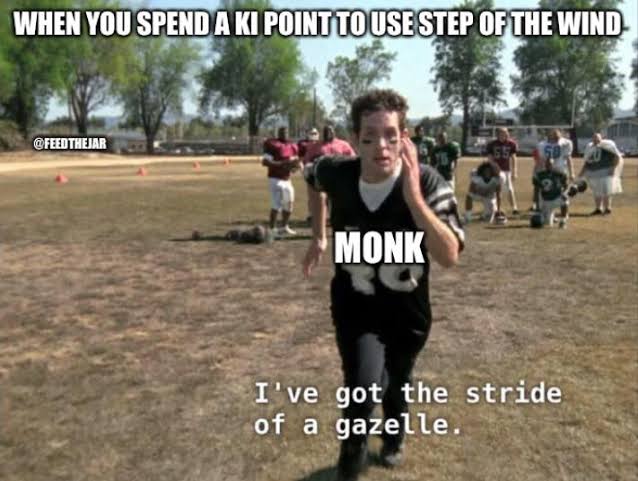
You can spend 1 ki point to take the Disengage or Dash action as a Bonus Action on Your Turn, and your jump distance is doubled for the turn.
Similar to the Rogue’s Cunning Action feature. Being able to attack and Disengage on the same turn, is a great way for a squishy front-liner like the Monk to hit and run. Because of Unarmored Movement, the Monk is better than most at this, getting us far out of reach of counterattacks.
Level 3
We get one core feature at this level and also get to choose our subclass. I’m not gonna go into subclasses in this post, but we’ll get there later.
Deflect Missiles
Starting at 3rd Level, you can use your Reaction to deflect or catch the missile when you are hit by a ranged weapon Attack. When you do so, the damage you take from the Attack is reduced by 1d 10 + your Dexterity modifier + your monk level.
If you reduce the damage to 0, you can catch the missile if it is small enough for you to hold in one hand and you have at least one hand free. If you catch a missile in this way, you can spend 1 ki point to make a ranged Attack (range 20 feet/60 feet) with the weapon or piece of Ammunition you just caught, as part of the same Reaction. You make this Attack with proficiency, regardless of your weapon Proficiencies, and the missile counts as a monk weapon for the Attack.
At low levels, when facing tons of archer mobs, this is fantastic! Unfortunately, ranged attacks become less weapon based, and more spell attacks as we gain levels. Still it’s a great option to have.
.jpeg)
Level 4
This level is important for because of the ability score improvement. If we look at our current spread of 17 Dex and 15 Wis, increasing each by one will increase both Modifiers, making it a better move than simply increasing our DeX by 2 points.
Taking this route, we now have 18 DeX (+4) and 16 Wis (+3). This gives us an important increase to our AC. We’ll be much harder to hit with 17 now. In addition our DPS will increase as well, furthermore the Ki save DC will increase as well.
Slow Fall
Beginning at 4th Level, you can use your Reaction when you fall to reduce any Falling damage you take by an amount equal to five times your monk level.
Falling is quite possibly the most embarrassing way to die. Slow Fall all but eliminates this possibility. Of course, this feature’s usefulness is largely dependent on your DM as well as the nature of your campaign. If it comes up, its incredible. Of course this makes this option technically situational.
Level 5
Level 5 is an important milestone for almost every class. The monk in particular gains improvements across the board. As with everyone else, our proficiency bonus increases to a +3 at this level. In addition our Unarmed Strikes increase to 1d6, dramatically increasing our damage output, especially when we consider our Flurry of Blows can be used far more frequently at this level, along with this next feature…
Extra Attack
Beginning at 5th Level, you can Attack twice, instead of once, whenever you take the Attack action on Your Turn.
I don’t think this feature requires any explanation. It’s incredible!
Stunning Strike
Starting at 5th Level, you can interfere with the flow of ki in an opponent’s body. When you hit another creature with a melee weapon Attack, you can spend 1 ki point to attempt a Stunning Strike. The target must succeed on a Constitution saving throw or be Stunned until the end of your next turn.
Arguably the best feature the Monk gets. Being able to Stun a creature is a powerful debuff on anyone. Tired of being blasted with a barrage of spells by an enemy spellcaster, hit them with this and their toast! Even against beefy tanks, this is still useful, as you can attempt to reapply the status on your turn. Now the save is Con based, which many creatures are good at, however you can attempt to Stun on every attack, provided you have the Ki, this gives you three attempts, or even four to get them to fail the save. Odds are, at least one of them will connect.
Level 6
We get another subclass feature at this level. Our movement speed also goes up to 50 feet, we’re even better at hit and run at this stage!
Ki Empowered Strikes
Starting at 6th level, your unarmed strikes count as magical for the purpose of overcoming Resistance and immunity to nonmagical attacks and damage.
This makes us even less reliant on equipment. Resistance and immunity to non magic attacks can be a massive problem, especially as some games don’t have magic items.
Level 7
This level also unlocks some pretty cool features for us to use.
Evasion
At 7th level, your instinctive agility lets you dodge out of the way of certain area Effects, such as a blue dragon’s lightning breath or a Fireball spell. When you are subjected to an Effect that allows you to make a Dexterity saving throw to take only half damage, you instead take no damage if you succeed on the saving throw, and only half damage if you fail.
An absolutely amazing effect! With our high Dex score and proficiency in saves, we are almost immune to AoE attacks!
Stillness of Mind
Starting at 7th level, you can use your action to end one Effect on yourself that is causing you to be Charmed or Frightened.
Outright immunity would have been better. Still, most effects that Charm or Frighten target Wisdom or Charisma. We already have high Wisdom, and Fey Ancestry goes a long way in protecting us against Charm. All the same, both of these conditions can easily get you out of a fight for extended periods of time. Even though it uses an action, it will still get you back into a fight sooner than attempting a save again.
Level 8
The next two levels are relatively quiet for the Monk. Still, the Ability Score increases is always useful. We can max out our Dex at this level, giving us a +5 in that score, also bumping our AC up to an 18.
Level 9
Even less goes on at this level. Our proficiency bonus goes up to a +4, so our Ki Save DC is now 15. We also get access to the second part of Unarmored movement, allowing us to run across water and up walls, giving us a good amount of new tactical advantages.
Level 10
We get another feature at this level, in addition to an extra 5 feet of movement.
Purity of Body
At 10th level, your mastery of the ki flowing through you makes you immune to disease and poison.
Poison and Disease are horrible conditions that can severely hamper your game. Flat out immunity to both makes taking on dangerous creatures like Aboleths easier.
Level 11
Our Martial Arts die increases to a d8 this level, matching a versatile spear, so you can rely exclusively on your fists from now on, unless you’ve picked up a +1/2 weapon.
We also grab another subclass feature.
Level 12
Another Ability Score Improvement let’s us get our Wisdom up to 18 (+4), we now have 19 AC, making us very difficult to nail with attacks. Our Ki Save is now 16.
Level 13
Proficiency bonus increase again! Ki Save DC looking great at 17 right now. We get another feature at this level as well.
Tongue of the Sun and Moon
Starting at 13th level, you learn to touch the ki of other minds so that you understand all spoken Languages. Moreover, any creature that can understand a language can understand what you say.
Let’s be real here, you dumped your Charisma and haven’t increased it all this time, so you’re not gonna be serving your party’s Face. However, that is only the tip of the iceberg in this case. The major advantage I can see is it dramatically improves your capabilities as a Scout or infiltrator.
Level 14
Yay, another 5 feet of movement! This puts our total movement speed at 60 feet right now, making us twice as fast as most other humanoids. Our hit and run tactics are almost at their peak at this stage.
We also get our hands on one of the most broken abilities in the game.
Diamond Soul
Beginning at 14th level, your mastery of ki grants you proficiency in all Saving Throws.
Additionally, whenever you make a saving throw and fail, you can spend 1 ki point to reroll it and take the second result.
Proficiency in all saving throws is huge! It also makes you less dependent on having high stats across the board to protect you from all the nastiness hostiles are going to be throwing at you. This part of the ability alone would have been enough, but when it comes to saving your life, a single ki point is a small price to pay.
Level 15
Before we continue, most adventure modules end at level 14. So many players consider level 14 to be the capstone, which is amazing in the Monk’s case.
That being said, level 15 is pretty much a dead level for the Monk. We only get one feature, and it’s pretty stale.
Timeless Body
At 15th level, your ki sustains you so that you suffer none of the Frailty of old age, and you can’t be aged magically. You can still die of old age, however. In addition, you no longer need food or water.
Much of this ability’s usefulness depends on how strict your DM is. At this level, food and water is the least of your problems. Otherwise, this ability will very rarely have an impact on your game.
Level 16
Another Ability Score Improvement at this level. On this one, I’d actually recommend taking 1 point to Con to increase our modifier to a +2, which gets us a whopping 16 HP. The other one can towards maxing our Wisdom out.
Level 17
Another Subclass feature at this level. We also get a proficiency boost here, so our DC is now at 18. Our Martial Arts also becomes a d10, so you can ditch weapons once and for all!
Level 18
We get our final movement bonus here, if you haven’t been able to outrun things by now, you definitely will be. We also get a new feature now.
Empty Body
Beginning at 18th level, you can use your action to spend 4 ki points to become Invisible for 1 minute. During that time, you also have Resistance to all damage but force damage.
Additionally, you can spend 8 ki points to cast the Astral Projection spell, without needing material Components. When you do so, you can’t take any other creatures with you.
Invisibility is incredible! Resistance to almost all damage is even better. Most combat situations don’t last much longer than a minute in game, so you can spend the majority of the fight punching things undetected.
The second part of the feature is far more situational, but it’s a great option when you need it.
Level 19
We’re almost at the end folks! We have our final Ability Score Improvement at this level. Now, if you’re happy with your Wisdom Score, you should consider a feat. I recommend Observant which will max your Wisdom, giving you a 20 AC and a save DC of 19.
Otherwise, Alert, Tough and Lucky are all solid picks.
Level 20
If you’ve made it all the way to level 20, go ahead and pat yourself on the back son, because it’s been a long, long road to reach this point. We have only our capstone feature left, so let’s not waste any time.
Perfect Self
At 20th level, when you roll for Initiative and have no ki points remaining, you regain 4 ki points.
Considering you have 20 points to burn through at this level, this feature is a bit of a let down. All the same, it’s great to have this backup if you just need that little push to get yourself through the day before you take a rest. Just make sure to never finish a fight with less than 3 Ki points or else this ability is pointless.
Notes
Unfortunately, the Monks dependence on three separate scores makes it difficult to justify taking feats over Ability Score Improvements in most cases. With regards to mapping those out, I think you can do them in any order after level 8, once you’ve maxed your Dexterity.
Summary
Monks are one of my favorite classes in D&D and writing this guide was a lot of fun. I’ll be doing a breakdown of Monk Subclasses next, so do feel free to check that out as well.

 Mechatronic Burst Gaming